
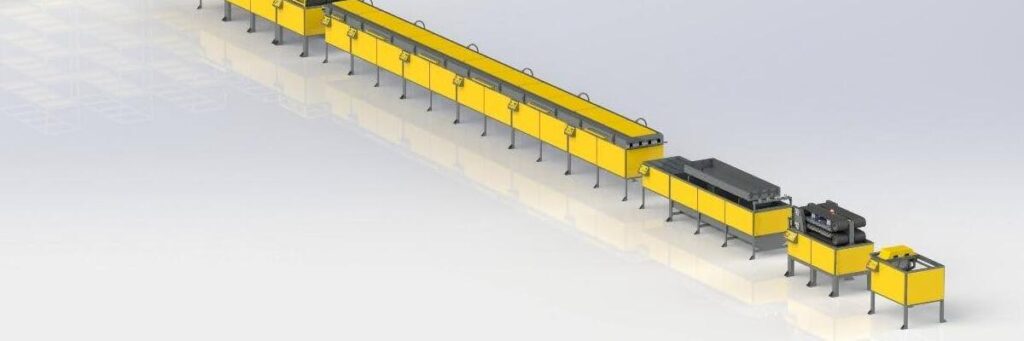
An engineering guide to fiberglass reinforcement mesh manufacturing, production equipment, industrial processes and factory productivity.
Fiberglass reinforcement mesh is becoming an increasingly interesting product for manufacturers of composite construction materials. Unlike straight GFRP rebar, which is sold primarily by linear length, reinforcement mesh is commonly supplied in sheets or rolls and measured by square feet or square meters. This difference creates an opportunity for manufacturers to serve customers who need reinforcement distributed across large concrete surfaces.
Industrial floors, concrete slabs, pavements and precast products are among the applications where composite reinforcement grids may be considered, subject to appropriate engineering design and product qualification.
But how is fiberglass reinforcement mesh actually manufactured?
At first glance, the process appears straightforward. Longitudinal and transverse reinforcing elements are arranged into a grid and connected at their intersections. In reality, industrial FRP mesh production requires precise control over fiber preparation, resin impregnation, bar geometry, intersection formation, polymerization and cooling. The equipment must perform these operations continuously while maintaining consistent mesh spacing and product quality. Composite-Tech develops specialized machinery for this purpose.
Its FRP mesh production technologies include continuous mesh forming and twisting systems, as well as equipment configurations that manufacture reinforcing rods separately before assembling them into a grid. Understanding these manufacturing methods is essential for companies planning to enter the fiberglass mesh production business.
Quick Answer: How Is Fiberglass Reinforcement Mesh Made?
Fiberglass reinforcement mesh is manufactured by combining glass fiber reinforced polymer rods or fiber bundles into a two-directional grid, connecting the longitudinal and transverse elements, and completing the required curing and finishing operations.
The precise manufacturing process depends on the equipment.
In Composite-Tech’s CT-Mesh continuous production system, glass fiber rovings are prepared, impregnated with resin and fed through a specialized weaving module. Transverse reinforcing elements are introduced at programmed intervals, and the mesh is formed using a twisting-based connection process.
The assembled reinforcement passes through curing ovens, cooling equipment and a pulling and cutting system.
Another manufacturing method produces composite rods first and subsequently joins them in a separate mesh assembly machine.
Both approaches can manufacture composite reinforcement grids, but their equipment configurations, connection mechanisms and production characteristics differ.
For investors, the most important factors are the required rod diameter, mesh width, cell spacing, production capacity and finished-product performance.
What Is Fiberglass Reinforcement Mesh?
Fiberglass reinforcement mesh is a grid-shaped composite product manufactured from glass fiber reinforced polymer. It consists of reinforcing members arranged in two directions. The longitudinal elements extend along the length of the mesh, while transverse elements cross them at specified intervals. Together, they form a repeating grid. The space between adjacent members is known as the mesh cell.
For example, a mesh described as 150 × 150 mm has nominal spacing of 150 mm, approximately 5.9 inches, in both directions.
The diameter of the reinforcing elements is another important characteristic. A product might use 3 mm, 4 mm or 6 mm reinforcing members, depending on its intended application and equipment configuration.
Fiberglass Reinforcement Mesh vs Conventional Fiberglass Textile Mesh
It is important to distinguish two different product categories.
- Fiberglass textile mesh is typically manufactured from relatively fine glass fiber yarns and is often used in plastering, rendering, insulation systems and other finishing applications.
- GFRP reinforcement mesh, by contrast, consists of composite reinforcing members with substantially larger cross-sectional dimensions and is intended for applications requiring a defined reinforcement function.
These products should not be treated as interchangeable. Their manufacturing methods, mechanical properties and engineering applications can differ significantly.
This article focuses on GFRP reinforcement mesh manufactured from composite reinforcing rods or fiber bundles.
What Materials Are Used to Manufacture GFRP Mesh?
The main raw materials are continuous reinforcing fibers and a compatible polymer resin system. Glass fiber is the most common option in GFRP reinforcement. Basalt fiber may also be used in suitable composite manufacturing configurations. The choice of resin depends on the intended product properties and manufacturing requirements.
Main Raw Materials
| Material | Function |
| Glass fiber roving | Provides reinforcement |
| Polymer resin | Forms the composite matrix |
| Curing agents | Enable resin polymerization where required |
| Processing additives | Adjust selected resin or production characteristics |
| Rib-forming material | Creates the required reinforcement surface profile where applicable |
| Prepared composite rods | Form transverse or longitudinal grid members in appropriate production configurations |
The interaction between the fibers and polymer matrix determines the behavior of the finished reinforcement. Fiber orientation, resin content, impregnation quality and curing conditions all influence the composite structure. For this reason, a professional production line must control more than the external dimensions of the mesh. It must also provide the conditions necessary for consistent material properties.
How the Continuous Fiberglass Mesh Manufacturing Process Works
Composite-Tech’s CT-Mesh equipment uses an integrated manufacturing process incorporating several coordinated modules.
For the CT M ST2-6 configuration described in the company’s technical documentation, the manufacturing system includes fiber creels, roving preparation, impregnation, weaving, polymerization, cooling, pulling and finishing equipment.
The production sequence can be summarized as follows:
Glass Fiber Preparation → Resin Impregnation → Mesh Formation → Intersection Twisting → Polymerization → Cooling → Pulling → Cutting or Rolling
Each stage performs a specific function.
Step 1: Fiber Feeding and Preparation
Production begins with continuous glass fiber rovings.
The rovings are supplied from bobbins installed on creels.
Guide rings direct the fibers toward the preparation system while helping maintain consistent feeding.
The fibers then pass through a roving heater.
This module is designed to distribute and warm the glass fiber strands before impregnation.
Fiber preparation matters because uneven feeding or uncontrolled tension can affect downstream manufacturing.
A stable supply of rovings helps the equipment maintain the intended geometry and process conditions.
Step 2: Resin Impregnation
The prepared fibers enter the resin impregnation system.
The polymer binder must penetrate the fiber bundles so that the finished composite can develop the required material structure.
The CT-Mesh impregnation module includes a resin bath and a pneumatic squeezing system.
The squeezing mechanism helps control excess resin as the impregnated fibers leave the module.
This is an important manufacturing operation.
Excessive resin consumption can increase material costs, while insufficient impregnation can create internal defects.
The objective is to achieve the appropriate resin content and distribution for the selected product.
The exact settings depend on fiber characteristics, resin viscosity and production speed.
Step 3: Preparing the Reinforcing Elements
A composite mesh consists of longitudinal and transverse members.
The CT-Mesh equipment supports a bar-production operating mode in addition to its mesh-production mode.
In bar mode, the equipment can manufacture composite reinforcement that is subsequently used in mesh production.
The manufacturer’s operating manual also recommends producing the longitudinal reinforcement on a dedicated FRP rebar production line where appropriate.
This can improve overall production organization and reduce the need to use mesh-production equipment for every preliminary operation.
The resulting production sequence depends on the selected factory configuration.
Step 4: Feeding the Transverse Reinforcement
During mesh manufacturing, transverse reinforcing elements are supplied to the weaving module.
The equipment includes a feeding mechanism and a cutting unit.
These prepare and position transverse members according to the selected cell spacing.
Accurate positioning is essential.
If the intended spacing is 150 mm, the machine must repeatedly place the transverse reinforcement at the corresponding programmed intervals.
The resulting grid must remain geometrically consistent across the product.
Step 5: Forming the Mesh Intersections
This is one of the defining stages of the process.
Composite-Tech’s documented CT M ST2-6 weaving module forms the mesh through a twisting operation.
The mechanism interweaves the reinforcing elements at the transverse connections.
This creates the required grid arrangement as production continues.
The weaving module is synchronized with the pulling system so that the transverse members are introduced at the correct intervals.
The required twisting operation must be coordinated with the selected reinforcement dimensions and production parameters.
The intersection-forming process is one of the principal differences between a fiberglass mesh machine and a conventional straight-rebar production line.
A rebar machine produces continuous individual reinforcing bars.
A mesh machine must additionally create accurate, repeatable connections between reinforcing members.
Step 6: Polymerization and Curing
After forming, the mesh passes through the heating section.
The CT M ST2-6 configuration includes three curing ovens.
These ovens provide controlled heating to support polymerization of the resin system.
The process develops the composite matrix as the grid moves continuously through the line.
Production speed must be compatible with the resin curing characteristics.
If the mesh travels too quickly through the curing section, the available heating time may be insufficient.
Therefore, manufacturers must select operating parameters according to the specific resin, reinforcement diameter and required product properties.
Step 7: Cooling
Following polymerization, the composite mesh enters the cooling module.
The cooling system reduces the product temperature before subsequent handling.
In the documented CT-Mesh configuration, the cooling module includes a water tank, pump and circulation components.
Cooling must remain coordinated with the continuous pulling process.
Step 8: Pulling and Cutting
A powered pulling system moves the mesh through the production line.
The same assembly includes a cutting module.
The required mesh length is set through the control system.
When the specified length is reached, the equipment performs the cutting operation.
This allows the manufacturer to produce mesh in selected lengths.
Step 9: Rolling and Product Handling
Depending on the equipment configuration and finished-product requirements, the mesh can be prepared as cut lengths or collected in rolls.
The CT-Mesh equipment range includes an optional roll-winding module.
The suitability of rolling depends on product geometry, rigidity and handling requirements.
The final product is then ready for inspection, packaging and delivery.
How Does Composite-Tech Control Mesh Cell Size?
Mesh cell geometry is one of the most important product characteristics. The cell dimensions determine the distance between reinforcing members. A smaller cell spacing creates more intersections over a given area. A larger spacing reduces the number of transverse members required over the same mesh length.
In Composite-Tech’s CT-Mesh system, the longitudinal spacing of transverse bars is configured through the machine control system.
For example, the operator can specify a cell length of 100 mm or 200 mm in supported configurations.
The control system coordinates transverse feeding, intersection formation and pulling. This allows the production equipment to manufacture different grid geometries without requiring an entirely different manufacturing principle. However, not every mesh configuration can be produced at the same speed. The number of intersection-forming operations increases as cell spacing decreases. That relationship directly affects manufacturing productivity.
Fiberglass Mesh Production Capacity: How Much Can One Machine Produce?
Production capacity is one of the first questions asked by companies considering FRP mesh manufacturing equipment. However, mesh productivity must be interpreted carefully.
For straight GFRP rebar, output is usually measured in linear meters or linear feet. For reinforcement mesh, it is often more useful to calculate production in square meters or square feet. That calculation depends on the mesh width and linear production speed.
For example, a machine producing a one-meter-wide mesh at 2 meters per minute has a theoretical area output of 2 square meters per minute.
The actual amount of finished, saleable mesh depends on operating utilization, production interruptions and product acceptance.
Composite-Tech CT M ST2-6: Documented Production Rates
Composite-Tech’s July 2024 operating manual provides the following indicative maximum production speeds for the CT M ST2-6 configuration.
| Rod Diameter | Cell Dimensions | Linear Production Speed | Theoretical Area Output per 8 Hours at 1 m Width |
| 2 mm | 100 × 100 mm | 1.5 m/min | 720 m² |
| 2 mm | 200 × 200 mm | 3.0 m/min | 1,440 m² |
| 4 mm | 100 × 100 mm | 1.0 m/min | 480 m² |
| 4 mm | 200 × 200 mm | 2.0 m/min | 960 m² |
| 6 mm | 100 × 100 mm | 0.75 m/min | 360 m² |
| 6 mm | 200 × 200 mm | 1.5 m/min | 720 m² |
Source: Composite-Tech CT M ST2-6 Installation and Operation Manual, July 2024. Area figures are calculated for a nominal 1-meter mesh width and uninterrupted eight-hour operation. Actual results depend on materials, curing conditions and production utilization.
These figures demonstrate why mesh configuration matters.
For example, manufacturing a mesh with 200 × 200 mm cells may permit a higher linear production rate than producing the same reinforcing diameter with 100 × 100 mm cells.
This is because the equipment performs fewer intersection-forming operations per meter of product. The precise relationship depends on the machine configuration.
Why Manufacturers Should Calculate Productivity in Square Feet
American customers frequently purchase reinforcement mesh in square feet.
For comparison: 1 square meter = approximately 10.764 square feet.
Thus, a theoretical output of 720 m² per shift corresponds to approximately 7,750 square feet.
A manufacturer should calculate output in both metric and U.S. customary units, particularly when preparing production budgets and quotations for American customers.
Are All Composite-Tech Mesh Production Lines the Same?
No.
Composite-Tech develops different equipment configurations for composite reinforcement mesh. The documented CT M ST2-6 configuration is intended for mesh up to 1 meter wide, using reinforcing members between 2 and 6 mm in diameter.
Other Composite-Tech equipment configurations are available for different mesh widths and reinforcement dimensions. The company’s product catalog describes both one-meter and two-meter mesh manufacturing systems.
Why Equipment Configuration Matters
A manufacturer producing relatively narrow grids may have different requirements from a company supplying wide reinforcement panels.
Likewise, a plant specializing in small-diameter mesh may require a different configuration from a factory producing heavier reinforcement.
The most suitable production equipment depends on several variables.
| Product Requirement | Effect on Equipment Selection |
| Mesh width | Determines the required working width |
| Reinforcing rod diameter | Influences fiber consumption and processing |
| Cell dimensions | Influence transverse feeding and production speed |
| Product format | Determines cutting and rolling requirements |
| Resin system | Influences impregnation and curing |
| Planned output | Determines required machine capacity |
| Available factory space | Influences equipment placement |
| Customer specifications | Determine required product properties |
For this reason, the specifications of an individual machine should not be treated as universal limits for every CT-Mesh model.
Manufacturers should request a configuration based on their intended product assortment.
Another Manufacturing Method: Mesh Made from Pre-Produced Composite Rods
Another Manufacturing Method: Mesh Made from Pre-Produced Composite Rods
Continuous weaving and twisting is not the only method used to manufacture fiberglass reinforcement mesh. Another approach separates rod manufacturing from mesh assembly. In this configuration, one machine manufactures composite reinforcement rods. A second machine assembles those rods into mesh.
Composite-Tech has documented a two-machine configuration using a CT2 Light rod-production system and a separate thermal joining machine.
How the Two-Machine Process Works
First, composite rods are manufactured.
The rod-production equipment processes glass fiber and polymer resin to manufacture continuous reinforcement.
The rods are collected on spools.
Next, the rods are transferred to the mesh assembly machine.
The equipment feeds the longitudinal and transverse members into the required grid arrangement.
Then, the intersections are joined using the machine’s thermal connection process.
The exact connection mechanism must be compatible with the composite material system.
It should not be assumed that a fully cured thermoset rod can simply be melted and welded like a thermoplastic.
Finally, the completed mesh is collected in the required format.
The documented two-machine configuration supports reinforcing rods from 2 to 4 mm and mesh widths up to 2 meters.
The referenced technical description lists 50 × 50 mm and 100 × 100 mm cell configurations.
These specifications apply to that particular equipment arrangement.
Why Use Separate Rod and Mesh Machines?
Separating rod production from mesh assembly can provide operational flexibility. A manufacturer can organize rod production and mesh assembly as distinct stages. However, this approach also requires additional material handling and coordination between the machines.
The best manufacturing method depends on the intended product, production volume and required intersection performance.
The most important question is not which process appears simpler. It is which process can consistently manufacture the required mesh at an acceptable cost and quality.
Why Mesh Intersections Are So Important
The intersection is a critical feature of reinforcement mesh.
Individual rods may have excellent tensile properties, but the assembled grid must also maintain its geometry during handling, installation and service.
Depending on the intended application, intersection behavior can influence the performance of the reinforcement system.
A manufacturer should therefore evaluate more than the strength of the individual rods.
Important considerations include intersection integrity, dimensional consistency, resistance to handling damage and relevant mechanical performance.
Different intersection technologies may produce different joint characteristics.
Twisted connections and thermally formed joints should not be assumed to behave identically.
Where the mesh is intended for structural reinforcement, appropriate product testing and engineering evaluation are essential.
This is particularly important in the United States, where product acceptance depends on the applicable construction codes, project requirements and supporting technical documentation.
Quality Control in Fiberglass Reinforcement Mesh Production
Consistent product quality is essential for manufacturers intending to supply professional construction markets. A reliable quality control system should address both the composite reinforcing elements and the assembled mesh.
Important Quality Control Parameters
| Parameter | Why It Matters |
| Fiber specification | Influences reinforcement properties |
| Resin formulation | Influences matrix performance |
| Impregnation quality | Influences internal composite consistency |
| Reinforcing member diameter | Influences geometry and mechanical properties |
| Cell spacing | Determines reinforcement distribution |
| Mesh width | Determines finished-product dimensions |
| Intersection consistency | Influences grid integrity |
| Degree of cure | Influences matrix properties |
| Surface quality | Helps identify manufacturing defects |
| Batch traceability | Links finished products to production records |
The inspection program should reflect the intended application and product specification. Where required, the manufacturer should perform mechanical and physical testing. Visible inspection is useful, but it cannot establish every material property.
For example, a reinforcement grid may appear correctly formed while still requiring verification of the mechanical properties of its rods or intersections.A professional factory should therefore combine process monitoring with appropriate finished-product testing.
Is Fiberglass Reinforcement Mesh Covered by ASTM D7957?
This is an important distinction for manufacturers entering the U.S. market.
ASTM D7957/D7957M-26 is a product specification for qualifying GFRP reinforcing bars. It does not cover premanufactured FRP grids and gratings.
The standard addresses the properties and qualification of certain GFRP bars supplied in cut lengths and bent shapes. It should not be presented as a general certification standard for every fiberglass mesh product.
Likewise, manufacturing mesh from rods that meet a particular bar specification does not automatically establish compliance of the assembled mesh with all requirements of a construction project. The finished grid may require additional testing, product evaluation or engineering approval. The applicable requirements depend on the intended use and jurisdiction.
Why Fiberglass Mesh Manufacturing Is an Interesting Business Opportunity
A manufacturer entering the composite reinforcement market has several possible product strategies.
The company can produce straight GFRP rebar.
It can manufacture reinforcement mesh.
Or it can develop an integrated product range.
Mesh presents an interesting commercial opportunity because it is generally purchased by area rather than by individual linear length.
Customers may require repeated grid configurations across large concrete surfaces. This can create opportunities for standardized manufacturing and distribution.
For example, a producer might concentrate on a limited range of frequently requested mesh dimensions.
Once those products are qualified for their intended applications and the manufacturer develops reliable demand, production planning can become more predictable.
Potential Customer Categories
Manufacturers may explore demand from industrial flooring contractors, precast concrete producers, construction material distributors, pavement contractors and companies working in corrosive environments. However, not every application permits direct substitution of steel reinforcement with fiberglass mesh.
GFRP has different stiffness, strength and failure characteristics from steel. The relevant engineering design and product acceptance requirements must therefore be evaluated.
The commercial opportunity comes from supplying suitable, documented reinforcement products—not from assuming fiberglass mesh can replace every steel mesh application.
How Production Technology Influences Manufacturing Economics
The profitability of fiberglass mesh manufacturing depends on several variables. These include raw material prices, product geometry, line speed, labor requirements, electricity consumption, manufacturing yield and selling price.
Mesh width and cell spacing are especially important because they influence the quantity of reinforcement required per square meter.
A smaller cell size generally means more reinforcing material and more intersections within the same area. This affects both material consumption and production time.
The manufacturing method also matters. A continuous mesh production system has a different operating structure from a two-machine configuration in which rods are manufactured separately and then assembled.
Main Economic Factors
| Manufacturing Factor | Economic Significance |
| Fiber and resin prices | Direct material cost |
| Rod diameter | Material consumption |
| Mesh cell dimensions | Material quantity per square meter |
| Mesh width | Area output per linear meter |
| Production speed | Output per operating hour |
| Connection method | Processing time and equipment requirements |
| Labor | Direct operating cost |
| Energy consumption | Manufacturing expense |
| Rejected production | Loss of material and productive capacity |
| Product qualification | Access to intended markets |
The appropriate financial measure is the complete manufacturing cost per square meter or square foot of saleable mesh.
A manufacturer should calculate this cost for the specific products it intends to sell.
The highest nominal machine speed is not necessarily the most profitable operating point if product quality or customer demand cannot support it.
Can One Factory Manufacture Both GFRP Rebar and Fiberglass Mesh?
Yes.
An integrated composite reinforcement factory can operate dedicated equipment for straight reinforcement and mesh. This arrangement creates opportunities to supply different products to the same construction market.
For example, a manufacturer may supply straight GFRP bars to a distributor and reinforcement grids to a precast producer.
The two products use related composite manufacturing principles, but their production processes differ.
Straight rebar production primarily focuses on creating individual reinforcing members.
Mesh manufacturing additionally requires accurate transverse placement and intersection formation.
Composite-Tech offers dedicated equipment for both categories.
Its CT6 New Generation is designed for high-output straight reinforcement manufacturing.
Its CT-Mesh equipment is developed for producing composite reinforcement grids.
For manufacturers planning long-term expansion, these technologies can form complementary parts of a broader product portfolio.
Why Choose Composite-Tech FRP Mesh Production Equipment?
Composite-Tech develops industrial equipment for manufacturing fiber-reinforced polymer reinforcement. The company’s equipment portfolio includes production lines for GFRP rebar, FRP reinforcement mesh and factory-made bent composite elements.
Its mesh manufacturing technology incorporates specialized systems for fiber preparation, resin impregnation, grid formation, curing, cooling and automated finishing.
The CT-Mesh production concept is designed to coordinate these stages within a continuous manufacturing process.
Composite-Tech also provides technical support for equipment selection, factory planning, installation, commissioning and operator training.
For companies considering a fiberglass mesh manufacturing business, the objective is to select an equipment configuration that matches the intended products and required manufacturing output.
The factory must then establish appropriate material processing procedures, product testing and quality control.
A successful reinforcement mesh business depends on the combination of manufacturing technology, product consistency and reliable customer demand.
Start a Fiberglass Reinforcement Mesh Manufacturing Business with Composite-Tech
Fiberglass reinforcement mesh manufacturing combines composite processing technology with a product format used across multiple construction applications. Modern production equipment must control fiber preparation, impregnation, grid geometry, intersections, curing and finishing. Composite-Tech develops industrial manufacturing systems designed for these requirements.
Whether you are planning a dedicated mesh manufacturing facility or expanding an existing GFRP rebar factory, selecting the right production configuration is an important first step.
Contact Composite-Tech USA to discuss your FRP mesh manufacturing project. Our team can help evaluate the required mesh dimensions, production capacity, equipment configuration, factory layout and startup requirements.
Composite-Tech USA — Advanced Equipment for GFRP Rebar and Fiberglass Reinforcement Mesh Manufacturing.
Conclusion
Fiberglass reinforcement mesh manufacturing requires more than arranging composite rods into a grid. A professional production process must control raw materials, impregnation, reinforcing member geometry, intersection formation, polymerization and finishing. Different production technologies achieve these objectives through different equipment configurations.
Composite-Tech offers continuous mesh manufacturing equipment based on controlled weaving and twisting, as well as documented configurations using separately manufactured rods and thermal joining.
For manufacturers, the right choice depends on product dimensions, required mechanical properties, production volumes and business objectives.
The real value of modern FRP mesh manufacturing equipment lies in its ability to produce consistent, saleable reinforcement grids efficiently and repeatedly.
That is the foundation of a competitive composite reinforcement manufacturing business.
Frequently Asked Questions About Fiberglass Mesh Manufacturing
How is fiberglass reinforcement mesh manufactured?
Fiberglass reinforcement mesh is manufactured by arranging composite reinforcing elements into a grid, connecting the intersections and completing the necessary curing and finishing processes. The exact method depends on the equipment technology.
What equipment is needed to manufacture fiberglass mesh?
A typical continuous system includes fiber creels, preparation equipment, resin impregnation, a mesh-forming module, curing ovens, cooling equipment, pulling and cutting systems. Some configurations also include rolling equipment.
What is the difference between fiberglass textile mesh and GFRP reinforcement mesh?
Fiberglass textile mesh is generally made from fine yarns and used in applications such as rendering and insulation systems. GFRP reinforcement mesh uses composite reinforcing elements intended for applications requiring defined mechanical reinforcement properties.
How are fiberglass mesh intersections connected?
Different production systems use different connection technologies. Composite-Tech’s documented CT M ST2-6 system uses a twisting-based weaving mechanism. Another documented equipment configuration uses a separate thermal joining process.
Can fiberglass mesh be produced in rolls?
Yes, depending on the reinforcing member diameter, mesh geometry and equipment configuration. Some Composite-Tech mesh production lines include optional roll-winding equipment.
What sizes of fiberglass reinforcement mesh can be manufactured?
Available dimensions depend on the equipment. Composite-Tech offers different mesh production configurations, including systems for one-meter and two-meter widths. Rod diameter and cell spacing limits vary by model.
How much fiberglass mesh can one production line manufacture?
Production capacity depends on the rod diameter, mesh width, cell spacing, resin system and machine configuration. For example, the CT M ST2-6 manual specifies an indicative maximum linear speed of 3 m/min for 2 mm reinforcement with 200 × 200 mm cells.
Is fiberglass mesh manufacturing profitable?
It can be profitable when selling prices, production volumes and manufacturing costs support a positive operating margin. A reliable business model should calculate cost per saleable square meter and include all relevant expenses.
Can the same factory manufacture GFRP rebar and FRP mesh?
Yes. A manufacturer can operate dedicated equipment for both products. The manufacturing processes share some raw materials and principles but require different equipment functions.
Does ASTM D7957 certify fiberglass reinforcement mesh?
No. ASTM D7957/D7957M-26 covers specified GFRP reinforcing bars and explicitly excludes premanufactured FRP grids and gratings. Mesh products require evaluation under the applicable project and product requirements.
Learn more: