
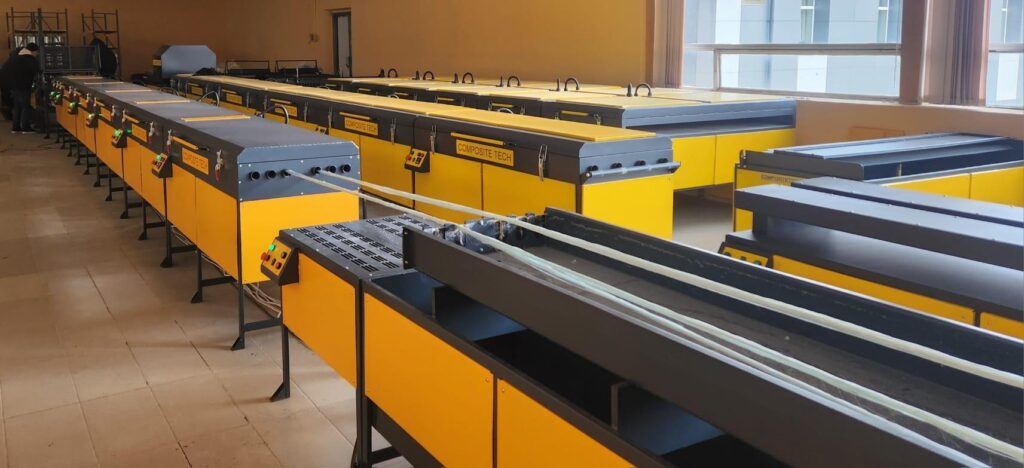
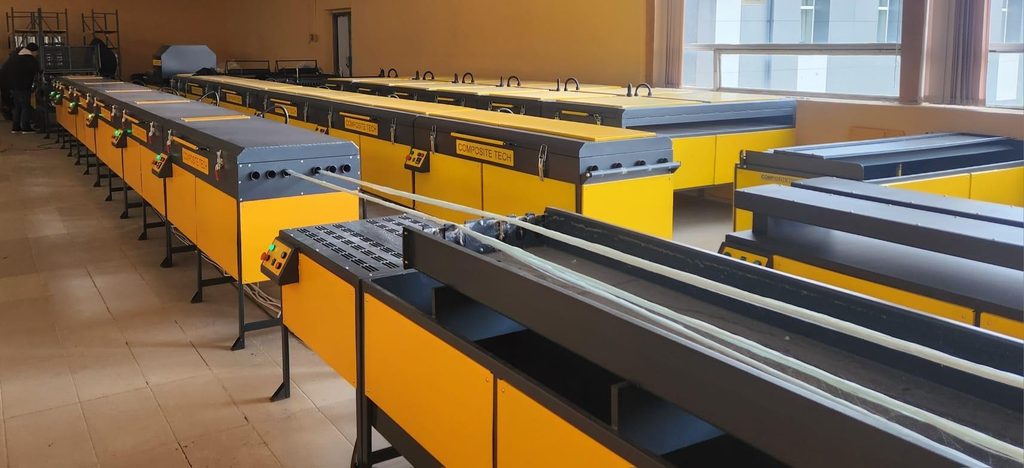
A production line quotation is only part of the budget for a new GFRP rebar plant. Before placing an order, you need to know what your customers will buy, how you will demonstrate product quality, and whether the building can support the complete manufacturing operation.
To start a GFRP rebar manufacturing business in the USA, define your first product range, select equipment for that range, arrange raw material supply and testing, prepare the facility, and fund the period between commissioning and customer payment. Those decisions belong in the same project plan.
At Composite-Tech, we manufacture equipment for GFRP rebar, mesh, and bent elements. This guide sets out the questions we recommend resolving before you commit to a line or sign a factory lease.
Start with the product your first customers need
“We will make fiberglass rebar” is a useful starting point, but it leaves most of the production specification open. A distributor may want stocked lengths in a small range of bar sizes. A precast producer may need a repeatable package of reinforcement for a particular product. A project supplier may need documentation and delivery schedules tied to individual contracts.
Write down the bar designations, nominal dimensions, lengths, surface profile, packaging, and documentation your intended buyers require. If buyers ask for #3 or #4 bars, carry those designations through the quotation and product drawings. Do not treat a rounded metric diameter as a complete product specification.
Then separate expressions of interest from realistic orders. Ask prospective customers which products they buy, how often they buy them, what prevents them from changing suppliers, and who approves a new product. A request for a sample is useful evidence of interest. It is not a production schedule.
Agree on the acceptance requirements before selecting equipment
A bar can look consistent and still require testing before a buyer accepts it. Discuss the required product specification, test reports, traceability, and any project-specific approval process early.
ASTM D7957/D7957M addresses solid round GFRP bars for concrete reinforcement. ACI CODE-440.11-22 addresses structural concrete reinforced with GFRP bars within its scope and refers to ASTM D7957-22. These documents have different roles: a product specification and a structural design code are not interchangeable.
The edition required by a customer or project matters. The newest published edition is not automatically the edition referenced by every contract or jurisdiction. Confirm the applicable requirements with the project team and the laboratory that will perform the testing.
Buying equipment does not, by itself, certify the bars produced on it. The product, raw materials, process settings, and quality procedures need to work together. Budget time and material for trial production, testing, and any adjustments before promising commercial deliveries.
Specify the process from roving to packaged bars
A GFRP rebar line brings continuous glass fibers together with a resin system, forms the bar and its surface profile, cures the material, and moves the finished product through cooling and cutting or suitable winding equipment. The arrangement depends on the line and the product being made.
For a closer look at the manufacturing stages, see our GFRP rebar production process guide on the international Composite-Tech website.
When comparing quotations, ask what is included at each stage. Does the proposal cover the required creel capacity, process controls, cooling equipment, cutting arrangement, and handling equipment? Which utilities must the factory provide? Which accessories are optional?
Also ask how operators record settings and respond to an interruption. A useful demonstration should show how the line starts, runs the specified product, stops, and returns to stable production. These details belong in the equipment discussion, even when the headline output looks attractive.
Our GFRP rebar production line information is a starting point for that discussion. The final configuration should follow your product specification and facility conditions.
Turn line speed into saleable output
Before using a quoted speed in a business plan, ask what it measures. Is it the travel speed of each bar, or the combined output from several bars produced at the same time? At what diameter, material formulation, and operating conditions was it measured?
The distinction changes the calculation. Consider an illustrative line producing four bars at 10 feet per minute per bar. Over an eight-hour shift, the theoretical output is:
4 bars × 10 ft/min × 480 minutes = 19,200 linear feet.
If productive running time is 75% of the shift and 97% of the resulting output is accepted, the planning estimate becomes:
19,200 × 0.75 × 0.97 = 13,968 saleable linear feet per shift.
This is an arithmetic example, not a Composite-Tech machine rating or a forecast for your plant. Its purpose is to make the assumptions visible. Changeovers, startup losses, maintenance, rejected material, and operator learning all need a place in the model.
Ask suppliers to state output by the products you intend to sell. A maximum speed for one bar size does not establish production capacity across the full range.
Check the building before you sign the lease
The machine footprint is only one part of the factory layout. You also need room to bring materials in, load the creels, inspect production, move finished bars, package orders, and reach the equipment for maintenance.
Draw the route of a finished bundle from the cutting area to the truck. Check door positions, turning space, storage racks, and the lengths you plan to ship. A building that accommodates the line may still be awkward for handling the product.
| Area to review | What to settle before ordering |
|---|---|
| Electrical supply | Available voltage, phase, frequency, connected load, protective equipment, and installation responsibilities. |
| Process utilities | Cooling arrangement, compressed air requirements, and any equipment supplied by the buyer. |
| Material storage | Supplier storage conditions, inventory space, handling access, and separation appropriate to the materials used. |
| Ventilation and work areas | Requirements based on the selected resin system, safety data sheets, processes, and local facility review. |
| Quality and dispatch | Space for inspection, sample storage, batch identification, packaging, and loading. |
Use the proposed equipment layout and the actual material information when reviewing the site with qualified local professionals. A generic factory drawing cannot establish the installation requirements for a particular building.
Build the budget around the first months of operation
Keep the equipment purchase, facility preparation, and working capital visible as separate parts of the budget. This makes it easier to see what a quotation covers and what the business still needs to finance.
Equipment-related costs can include tooling, accessories, freight, unloading, installation, training, and initial spare parts. Facility costs may include electrical work, utilities, racks, handling equipment, and preparation of production areas. Testing, raw materials, packaging, wages, insurance, and customer payment terms affect the cash needed to operate.
Calculate cost per saleable foot for each product. Use the actual material consumption and purchase prices, then add conversion costs and an explicit allowance for losses. Keep financing costs, depreciation, freight to the customer, and sales expenses visible rather than quietly omitting them.
A sensible model includes a slow-start case. What happens if qualification takes longer, the first shift runs below plan, or customers buy less than expected? Equipment capacity is useful only when the company can sell, deliver, and collect payment for the output.
Decide how mesh and bent elements fit the business
Some buyers need more than straight bars. Mesh and shaped reinforcement can therefore be relevant to the product plan, but they bring their own equipment, process, handling, and acceptance questions.
Review the commercial case for each product separately. Identify the dimensions and quantities customers need, the production route, and the documentation they will expect. Do not assume that qualification evidence for one product automatically covers another.
Composite-Tech offers GFRP mesh production equipment and GFRP bent elements production equipment alongside rebar lines. You can plan space and utilities for later expansion while choosing an initial investment that fits the orders you can realistically pursue.
Put commissioning and support in writing
Before signing, agree on what the factory must prepare, what the supplier will deliver, and how acceptance will be demonstrated. Name the product to be run during commissioning and the records that will be kept.
Clarify the training scope, documentation language, spare parts list, warranty terms, and support arrangements. For a U.S. plant, specify the electrical configuration and responsibilities for any required inspection or evaluation. General claims about international experience should lead to a precise project scope.
Composite-Tech currently has a U.S. representative presence and is preparing to manufacture equipment in Texas. For your order, confirm the manufacturing location, delivery schedule, and available support directly with our team. The location and scope of supply should be clear in the proposal.
What to send us for a useful equipment discussion
You do not need a finished feasibility study to begin. Send your proposed factory location, available floor plan, electrical supply details, intended bar sizes and lengths, target output, and expected customer requirements. If some decisions are still open, identify them.
That gives us a basis for discussing line configuration, layout, installation scope, and the next information you need. You can also read about our broader equipment range and company background on the Composite-Tech company information page.
Contact Composite-Tech USA to discuss your GFRP rebar plant. Include the products you want to manufacture and your target capacity so the conversation can start with a defined project.
Questions before starting a GFRP rebar plant
How much does it cost to start production?
The total depends on the line configuration, facility, installation scope, testing, and working capital. Compare quotations against the same product and operating requirements. A machine price alone is not a complete startup budget.
How much factory space is required?
Request a layout for the selected equipment and finished product lengths. Include material storage, access, quality checks, packaging, and loading. There is no single floor-area figure that fits every plant.
Does a production line guarantee ASTM-compliant rebar
No. Product conformity needs appropriate materials, process control, and testing against the applicable specification. Confirm the required evidence with your customer and testing laboratory.
Can I begin with rebar and expand later?
A phased investment is possible to plan. Discuss future products, available space, utilities, and separate equipment requirements before finalizing the initial layout.